Cassandra was a Trojan princess and priestess, best remembered for being a prophet who was always right, but never believed. The rest of her story is less well-remembered. More on that later.
To Tell the Truth
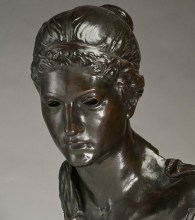 Cassandra only wanted to use her gift to prevent unnecessary suffering and death. But she told people things they didn’t want to hear, so she was pronounced insane, and ignored. Her own family, who had surely noticed her prophecies always came true, nevertheless locked her away, and dissed her along with the rest. They soon had reason to regret that, but by then it was too late.
When they let her out for a feast, she warned her father, the King of Troy, that the centerpiece, a giant wooden horse sent as a gift by Troy’s longtime rivals, the Greeks, was full of invading soldiers. Annoyed that she was bringing their party down, the king and his courtiers jeered at and insulted her.
Desperate to prove the truth, Cassandra grabbed an axe to break it open and show them what they would not let her tell them, but they took it away and laughed at her some more.
I don’t have to imagine how frustrating this was. I know. Like many HSPs, I often perceive things that others don’t. I learned a long time ago that these truths are not always welcomed by people who have not yet seen them (or are working very hard not to).
But wouldn’t you think immediate physical danger was a special case? It’s only natural that people would pay attention when it was a question of their own survival. Isn’t it?
Cassandra, being a lot more rational than she was given credit for, probably thought so too. But as we both learned the hard way, rationality has nothing do with it. When people don’t want to hear something, they’d rather pulverize the messenger and risk annihilation.
Countering COVID-19 misinformation with facts is a 21st century version of breaking open the Trojan horse to bring the danger to light, but like Cassandra, I’m getting pulverized for my efforts. The intensity and venom of the attacks has shocked and disheartened me.
The Mirror of Crisis
 How we react to a global crisis is bound to tell us something about ourselves. Upon contemplation, I have recognized that I expect emergencies to transform people, making them more honest, more mature, more empathetic. I expect them to rise above the petty, see the big picture, and put urgent needs first.
Although this may sound naive, there is some basis for it in my personal experience. I come from a region with severe winters, which unites strangers in common cause against the homicidal climate. One bitter winter night 40 years ago, after midnight, on a deserted country road, a couple stopped to pull a stranger’s car out of a snowy ditch.
As the temperature was -20°, this saved her life. Or rather, my life, and decades later, I am writing this post and you are reading it because of that action. The event, pivotal as it was for me, was common and unremarkable. If they are still living, they probably don’t remember it. I’d have done the same – anyone would. Perhaps I even did, and don’t remember it either.
But in spite of such evidences, “we’re all in this together” does not seem to be an innate instinct that kicks in during times of adversity — not for everyone, anyhow. Perhaps it must be learned from others and/or from experience to become the norm. When I moved to a gentler climate, it was conspicuously absent.
The Wages of Seeing
Getting back to Cassandra… What you may not have heard about her is that her life was one long #MeToo story. As a priestess, she took a vow of celibacy. Her god first attempted to seduce her with the gift of prophecy, but when she wouldn’t break her vow, he cursed her with being never believed, and unable to change what was coming. And they say hell hath no fury like a woman scorned!
Bearing no ill will towards males in general for this injustice, she taught prophecy to her twin brother, who, minus the curse, was always believed. He didn’t appreciate the favorable treatment Cassandra could only dream of, however, and ultimately assisted his father’s enemies in the fall of Troy.
Nice family.
Cassandra’s father tried to entice his neighbors into military alliances by dangling the beautiful, if reputedly crazy Cassandra as bait. This failed, but he still could’ve prevailed, if only he had listened to her about the Trojan horse.
As we know, he didn’t, and Cassandra’s home fell to the Greek invaders. If she had a moment of satisfaction in being proved right, it was a brief one. One of the invading “heroes” brutally raped her in the temple where she sought refuge. You probably have a scouring powder named after him under your sink.
He should have been stoned to death for this crime, but he got out of it by accusing the already much-maligned Cassandra of lying. The society of the time was decidedly more inclined to believe men than women (glad that’s changed, right?).
The goddess whose temple was doubly desecrated, not only by a rape within its walls, but by the rape of a priestess, was not deceived, however. She saw to it that the rapist never made it home. Wish we still had those around.
Being avenged was probably cold comfort to Cassandra, however, as she was soon delivered as spoils of war to yet another sovereign, who made her his concubine.
Unfortunately (if sexual slavery isn’t unfortunate enough), she landed in the middle of a struggle for the throne. After bearing the king twin children (probably not something she had a choice about), all four of them were murdered by the queen and her lover in a coup.
And that was the end of the short, sad life of Cassandra, who could look ahead and see what was to come. Histories are silent on whether she ever foretold her own fate. Surely not, or wouldn’t she have foreseen the futility of trying to save the others, and at least saved herself? But maybe she made the same mistake I did, and assumed when their very survival was on the line, they would finally listen.

Reality: Still Unpopular After All These Years
The much-mythologized traumatic life of a woman who may or may not have lived 3,000 years ago may not seem very relevant to my recent experiences on social media. But some things haven’t changed much.
The few, not the best few by a long shot, still make vastly awful decisions that result in the squandered lives of multitudes. The crowd still follows these same deficient few, even off the edges of cliffs, and attacks anyone who urges them to apply their own sense and senses in charting a safer path.
And truth-seers are still disparaged and ignored. If they are valued for anything, it is anything but their gift of perception. They still have to watch in horror as everything they predicted comes to pass. And they are still powerless to prevent it.
That’s my emotional response to the inescapable conclusion that some members of our species – and not a small number, alas – seem unswervingly, unrepentently determined to behave in ways that are detrimental to us all.
But being a somewhat self-aware HSP, while I pause to honor what I feel, I don’t mistake it for perception. Are we truly powerless? If the empathy that inspires and en-courages us doesn’t have the same effect on them, can we exercise our gift of insight to discover what might finally penetrate their lethal denial?
I think we must try.
Because, if not us, who??

 sensitive type