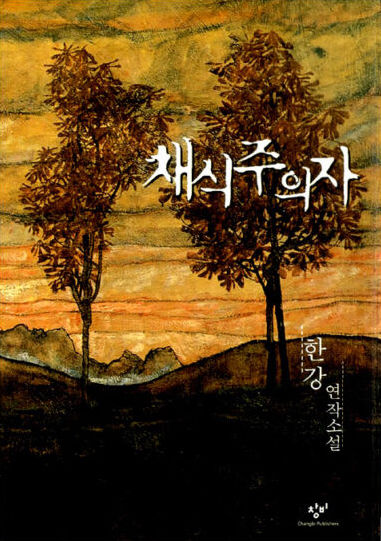
 I wrote this review in 2016, intending to publish it in a different venue, then forgot about it. I’ve added references to two films that came out after I wrote it.
As I discuss, it’s debatable whether The Vegetarian really qualifies as a feminist novel. It’s about people who have retreated so entirely into their wishful fantasy lives that they are incapable of accurately perceiving the world around them – or themselves. In our third year of COVID, this is more apropos than ever.
I don’t love the last paragraph. Focus was slipping away from me, and the final sentence is positively trite. Doubtless I meant to return to it and craft a more satisfying conclusion. Trite or no, though, re-reading it now, that last sentence grows upon and haunts me, with its prescience of tragically missed opportunities on a global scale that I had never conceived of when I wrote it. So it stands as written.
October 2016 – It has been a couple of months since I read The Vegetarian, a Korean novella by Han Kang. Although it was published in South Korea in 2007, it came to the attention of the English-speaking world earlier this year, when the 2015 translation won the Man Booker International Prize.
I discovered Korea in 2011, and have been fascinated by the contrasts and resonances between Korean and American culture ever since, so I was looking forward to reading The Vegetarian. It has been billed as a feminist novel, for one thing, and if ever a country needed feminism, it’s Korea. Also, I am a vegetarian, which is even rarer in Korea than it is in the US, so the title caught my attention, though I understood from the reviews that the vegetarianism was mostly allegorical. The reviews and a friend who read the book before I did warned me that it wasn’t what they expected.
I should’ve paid more attention to that. It turned out not to be what I expected either.
I sat with my reactions for awhile, hoping they would become clearer. They didn’t. The book confused me. Or rather, my reactions to it did.
It was a familiar confusion. The Vegetarian reminded me of a book I read when I was in high school. It was written by Frank Herbert, who is best known for his science fiction, particularly the Dune series, but it was quite different, both in style and setting. Soul Catcher (1972) is about a Native American man who abducts a European American boy. As I remember it, most of the book is told from the Native American man’s perspective. He believes he is carrying out a spiritual mission. And maybe he is. But then again, maybe – certainly – he’s a dangerous psychotic.

No doubt I was struck by the contrast between individual and societal perceptions in Soul Catcher because I was myself struggling to find a “reality orientation” within the chaotic tides of mental disorder at the time (though it would be another twenty years before I knew that). Soul Catcher caused me to ponder how it was possible to respect the subjective authenticity of multiple truths when they are mutually exclusive, a quandary I have yet to resolve.
The Vegetarian raised that question again, in a more personally disturbing way. The book is not really about the title character, who is also mentally ill, and whose first person voice is silent through most of the book. Rather it is a study of three others characters through the prism of their expectations, perceptions, and reactions concerning her.
I was quite disturbed by a certain sympathy I felt with a male character in the book who becomes obsessed with the vegetarian. His obsession takes the form of a deeply compelling creative inspiration, something I have experienced myself. Creativity is inherently nonrational, demanding a surrender and commitment to a uniquely personal reality that may make sense to no one else. But where’s the line between that and mental disorder – and how can you tell when you cross it?
One measure might be whether there is harm, but it is not at all clear that the vegetarian lives enough within consensus reality to experience being the focus of someone else’s obsession as a harm. On the other hand, the obsessed man’s life is destroyed by his obsession. He is pronounced sane as he exits the storyline, but I don’t fully trust the novel on that point.
This is where I start to feel uneasy with my sympathy, or maybe I mean empathy, with this character. Objectively speaking, he’s done an unforgivable thing to someone too vulnerable to protect herself. If I find anything to relate to in the mental and emotional states surrounding that, what does that make me??
But is the author really asking readers to define sides, and choose one? I realized I only felt obliged to do so because the novel had been characterized as “feminist.” By my definition, that would make it an exploration of impacts of an unequal gender class system upon its characters. However, as I ought to know by now, any time a man who treats a woman badly is portrayed unsympathetically, or a woman shows anger about it, this is labeled as feminist, regardless of whether it’s tied in to a larger pattern of attitudes or behaviors.
I have my doubts whether Han Kang intended a social statement about the status of women in Korean society to be the central focus of this book. Feminism is just beginning to get off the ground in Korea now, and this novel was written 10 years ago as a three-part series of character studies. Furthermore, feminism is a macro perspective, and everything about this novel is minutely micro.
The vegetarian’s relentlessly self-referential husband can certainly be extrapolated to a larger class of Korean men, but the same cannot be said of the novel’s other characters. The Vegetarian has more in common with Ken Kesey’s Sometimes a Great Notion than Marilyn French’s The Women’s Room (an iconically feminist novel).
We never really find out who the vegetarian is. The rare glimpses we get inside her mind reveal such an alien landscape that they bring us no closer to knowing her. Although she is at the center of the novel, she is also oddly absent. The other characters interact primarily with their thoughts and feelings about her rather than with the woman herself, and she is as unaware of them as they are of her.
Interestingly, the 2017 film Columbus, written and directed by Korean-American filmmaker Kogonada, also revolves around a character who has been a formative catalyst to most of the other characters and is constantly present through their perceptions of and reactions to him, but is not physically present for most of the film. Are stories constructed around the hollow center of a crucial yet absent character a Korean thing, I wonder, or is the similarity just a coincidence?
None of the characters in The Vegetarian interact with each other with any authenticity. If the novel has a message, it is perhaps that perpetual insincerity in relationships is so alienating and disorienting that it paves the way to extreme thoughts and acts (also a moral of the 2019 Oscar-winning Korean film, Parasite). That’s a relevant and rather radical message in Korea, where interactions and self expression at every level are rigidly constrained by the heavy hand of Confucian hierarchism.
There is a strong undercurrent of nature ecstasy in The Vegetarian, which seems almost independent of the characters and their stories, though it was the original inspiration for the book. The vegetarian ultimately bows out of the overpowering grief and contradictions of human existence by identifying with a simpler, more passive form of life. I think of this – not disrespectfully, I hope – as the Buddhist solution.
But renouncing agency is not a resolution, or at least not a good one. Though I too feel the attraction of it, I believe the human tendency to let others act for us may be our greatest flaw, and the one we most need to overcome if we are to sustain our coexistence as a species on this planet in any kind of positive way.
Retreat seems to be the only strategy The Vegetarian offers in the face of the unbearable, but I think this is meant as a cautionary tale with universal applicability: Don’t wait until renunciation is your only option. Don’t allow your identity to be subsumed by travesties of intimacy into a self so alienated that it recognizes neither boundaries nor anchors. If you can’t find yourself in your relationships, make or find better relationships. If you can’t be yourself in your culture, transform it. An ounce of prevention is worth a pound of cure.
 sensitive type