Thoughts About Overthinking

Blog posts and discussions about Sensory Processing Sensitivity (SPS) frequently refer to “overthinking” as an inevitable characteristic of being an HSP (Highly Sensitive Person). This always raises my hackles. What’s “over” about our thinking, compared to anyone else’s? And why are we comparing ourselves to anyone else anyway? Unfavorably at that? Haven’t we all heard “oversensitive” enough times not to apply any more “over-” appellations to ourselves??

And if the embedded judgment wasn’t bad enough, the term is also imprecise. I have detected at least three different meanings associated with the word. In this post, I discuss these definitions of “overthinking,” and propose alternatives for two of them.

Continue reading

Believe Me

Cassandra was a Trojan princess and priestess, best remembered for being a prophet who was always right, but never believed. The rest of her story is less well-remembered. More on that later.

To Tell the Truth

Bronze casting of a pensive young woman in ancient dress with holes for eyesCassandra only wanted to use her gift to prevent unnecessary suffering and death. But she told people things they didn’t want to hear, so she was pronounced insane, and ignored. Her own family, who had surely noticed her prophecies always came true, nevertheless locked her away, and dissed her along with the rest. They soon had reason to regret that, but by then it was too late.

When they let her out for a feast, she warned her father, the King of Troy, that the centerpiece, a giant wooden horse sent as a gift by Troy’s longtime rivals, the Greeks, was full of invading soldiers. Annoyed that she was bringing their party down, the king and his courtiers jeered at and insulted her.

Desperate to prove the truth, Cassandra grabbed an axe to break it open and show them what they would not let her tell them, but they took it away and laughed at her some more.

I don’t have to imagine how frustrating this was. I know. Like many HSPs, I often perceive things that others don’t. I learned a long time ago that these truths are not always welcomed by people who have not yet seen them (or are working very hard not to). 

But wouldn’t you think immediate physical danger was a special case? It’s only natural that people would pay attention when it was a question of their own survival. Isn’t it? Continue reading

Rest

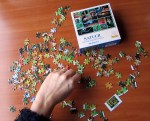
A slim hand moves jigsaw puzzle pieces laid out on a table.Having accomplished a self-directed life where I answer to no clock but my own, I struggle constantly with the balance between activity and down time. I often suspect the struggle is with self-judgment rather than time management, but I’m never quite confident enough of that to surrender myself wholeheartedly to my periods of rest. Maybe that’s why I need so much of it!

Like most human experiences, this one is neither unique to me, nor new. It was with a dawning sense of vindication that I listened to the following articulate and compassionate defense of down time from a book published by Herbert J. Hall more than a century ago. Hall received his M.D. from Harvard in 1895, and soon gravitated towards patients with “nervous complaints.” He was clearly well-acquainted with negative self talk long before the phrase was coined.

Here is a chapter from his 1915 book, The Untroubled Mind, now in the public domain. Continue reading

Terra Infirma

I knew I was living in a protected bubble, where life AC (After COVID-19) was not so very different from life BC. I knew there were similar pockets throughout the U.S. While I was grateful for the relative safety of my situation, the sense of removal from the chaotic centers of the pandemic has its down side. Many in my suburban city refuse to change their behavior. They are worried enough to hoard toilet paper, but not enough to keep their distance in the checkout line. They don’t know anyone who died yet.

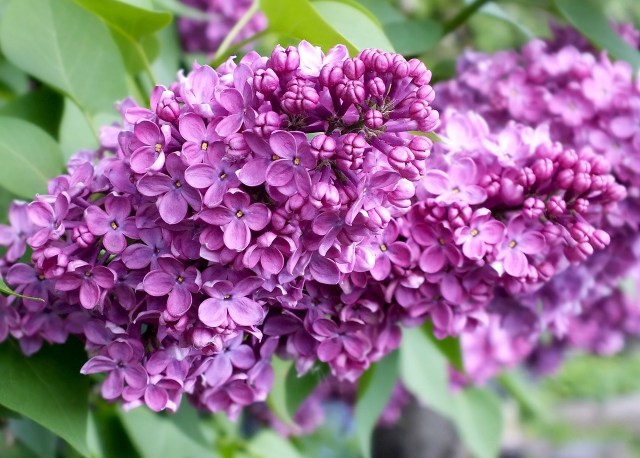
Two blooming purple lilac flower heads

The disconnect between the quiet streets here, blooming with spring, and the fact that we are in the midst of a global tragedy that must change us in ways we can’t even begin to imagine felt increasingly surreal as I read of very different scenarios elsewhere – Italy, Spain, hospitals in New York. But still, I worked my past experiences with making do, getting through it, living with uncertainty, and sheltering in place from my own HSP overwhelm. I told myself calmly and rationally that the brightest and best-trained minds on the planet are working on this, Continue reading

Coping

I wonder if HSPs have an advantage in a crisis, as we are already very familiar with overwhelm. While that’s no guarantee that we are better equipped to deal with it, at least it’s not a new feeling. If we have learned to balance our sensitivities with a sense of perspective, perhaps we can rediscover sooner than others that our emotional reaction is not a measure of our capacity to cope.

Global pandemic really shouldn’t surprise anyone, as we have had a high level of rapid international travel for at least 70 years. What’s surprising is that it didn’t happen sooner. I don’t expect that to be a comfort, but I am ever-hopeful it will promote facing and planning for other future challenges (not holding my breath, though).

Hunkered Down

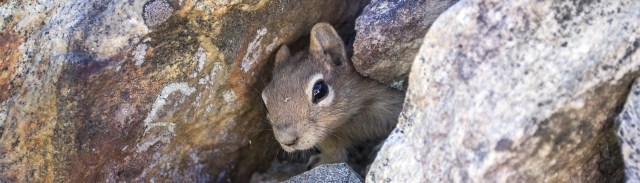
A chipmunk peers warily out from between large boulders
Continue reading

Remind Me Where I Know You From

As if there wasn’t enough weirdness in my brain, I live with mild prosopagnosia, also known as face blindness. I recently came across this great podcast on the subject, that updated latest research findings, as well as providing a few facts I hadn’t known.


Smiling face of a woman with features blurredI first heard of prosopagnosia about a dozen years ago, in a documentary about a woman who couldn’t recognize members of her own family, with whom she lived. I watched it for the same reasons anyone would – curiosity, and wondering what her very different life might be like.


However, as the documentary described how people with less severe cases of the condition may not even be aware of it, and instead think they have trouble with names, or just need to pay more attention, it began to sound unexpectedly familiar. Continue reading

Risk

A wild goat leaps from one high rock to another against the background of a valley far below, while another goat loks inquisitively into the camera
I have observed that I have a somewhat different perspective on risk from some of my friends. They measure risk – and decide whether to take preventive steps – based on their assessment of how likely an undesirable event is. I, on the other hand, weigh risk and how much preventive action is warranted according to how much of a hassle it would be if it did happen.

Since sensory processing sensitivity is often described in terms of risk aversion, especially in animal studies, I am curious whether HSPs in general identify more strongly with one of the above attitudes towards risk than with the other? Let’s call them “odds” vs “cost.” If you have a moment, please fill out the poll below. Not scientific, of course, but potentially interesting. (If you don’t see the poll, try a different browser or device).

Minutiae

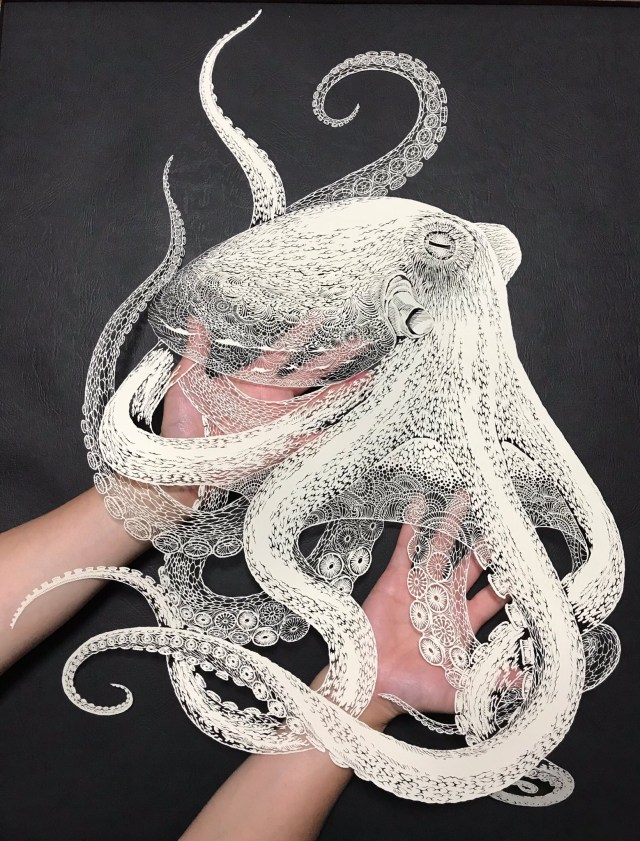
If you face each detail – calmly, patiently, steadily – look how the whole can turn out in time.

An extremely intricate octopus papercut, with thousands of teeny cutouts from a single sheet to create the impression of skin textures and overlap, laid across the artist's palms.

Octopus cut from a single sheet by kirie artist Masayo Fukuda (Article)

Mindfull

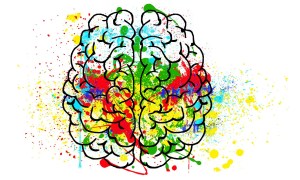
Line drawing of brain splashed with brilliant colorsIt’s been an intense week. First, the election, loaded not only nationally but locally, due to a corruption scandal. Then, ANOTHER mass shooting, also close to home given my history with country western dance bars and mental disorders. And to top it all off, the weather, after being mild and steady for months, suddenly went kerflui in a very extreme way. For days. Still is, in fact.

My motivation level is barely registering on the meter. OTOH, confusion is high, as I ponder for the umptee-millionth time where the line is between necessary downtime, and a slide into depression to which I should be responding in some remedial way. I was thinking my depression management plan isn’t effective enough, and researching things I could add. Then I was thinking I already had good tools, but wasn’t using them, so maybe adding more tools wasn’t the solution. I was thinking how I have longed to be living in the country for the past 30 years, and yet, I’m not.

In the midst of all of this, I found myself conducting “where are they now” web searches about people I used to know, which is something I do from time to time. This morning, they led me to the years-old blog of someone I had never met, who was the partner of someone with whom I was once (or rather, twice) close friends. She was having a transformational year, and as she blogged, it was transformational to me, too. Transformation isn’t something you can convey descriptively. It wasn’t what she said, it was the way she said it. Continue reading