Mindfull

Line drawing of brain splashed with brilliant colorsIt’s been an intense week. First, the election, loaded not only nationally but locally, due to a corruption scandal. Then, ANOTHER mass shooting, also close to home given my history with country western dance bars and mental disorders. And to top it all off, the weather, after being mild and steady for months, suddenly went kerflui in a very extreme way. For days. Still is, in fact.

My motivation level is barely registering on the meter. OTOH, confusion is high, as I ponder for the umptee-millionth time where the line is between necessary downtime, and a slide into depression to which I should be responding in some remedial way. I was thinking my depression management plan isn’t effective enough, and researching things I could add. Then I was thinking I already had good tools, but wasn’t using them, so maybe adding more tools wasn’t the solution. I was thinking how I have longed to be living in the country for the past 30 years, and yet, I’m not.

In the midst of all of this, I found myself conducting “where are they now” web searches about people I used to know, which is something I do from time to time. This morning, they led me to the years-old blog of someone I had never met, who was the partner of someone with whom I was once (or rather, twice) close friends. She was having a transformational year, and as she blogged, it was transformational to me, too. Transformation isn’t something you can convey descriptively. It wasn’t what she said, it was the way she said it. Continue reading


Introvale is a State of Mind

Green letter M logo of Medium.comI’ve been hearing buzz about Medium here and there for awhile now. If you haven’t heard of it yet, it’s a newish online sharing platform meant for deeper, more thoughtful articles and responses than social media and commercial sharing venues typically offer.

Social “Medium” for Introverts

That sounds like something designed by (and for) introverts, no?

But I’ve been scrambling to make financial ends at least wave at each other from opposite ends of the block, so it wasn’t until tonight that I finally took a look.

I didn’t look far before I found Multitasking is Killing Your Brain. Hah! I was right! It’s a den of introverts! Here I was thinking Introvale was a physical space. Silly me.

A straight road across a wooded plain appears intermittently between the trees

Quiet Revisited

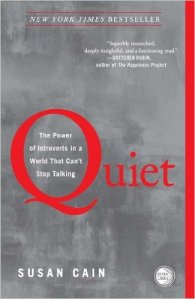
The cover of the book Quiet: The Power of Introverts in a World That Can't Stop Talking by Susan CainJenna, my comrade in bloggery over at The Wishing Well, just published a post about Susan Cain’s book, Quiet: The Power of Introverts in a World That Can’t Stop Talking. To my great surprise, her reaction to it was very different from mine. Since I had recommended it to her enthusiastically, I started out writing a reply in a comment, but it became way too long, so I’m publishing it here.

Wow, did we read the same book? Before I read Quiet, it had literally never crossed my mind that I was an introvert, much less an HSP (which Elaine Aron believes Susan Cain also is). I thought I was an extrovert inhibited by a tendency to isolate. I defended this, extolling the joys of solitude, as I still do. However, before I read Quiet, those joys were seriously undermined by my secret fear that solitude was an unhealthy indulgence, an escape from my shameful inability to interact “normally.” Whether it was my failure to produce extroverted bubble and bounce on command, or my persistent inclination towards behavior I had been taught was dysfunctional, I was coming up short no matter what I did. Continue reading

How the Light Gets In

Ring the bells that still can ring
Forget your perfect offering
There is a crack in everything
That’s how the light gets in

Leonard Cohen

A bean of light shines into a cave through a hole at one side

SensitiveType on Facebook

My brain is abuzz with all of the things I read and see that I want to share with you. The backlog is getting too huge to ever catch up, though, so I set up a Facebook page where I can post things that don’t make it into a SensitiveType blog post. Check it out (there’s also a link in the right sidebar).
A screenshot of the SensitiveType Facebook page

HSP Videos

Here are a few of my favorite HSP-related videos for your viewing enjoyment, or to share with people in your life who may not be ready for the whole movie yet.

Signs You Might be a Highly Sensitive Person

Signs You Might Be Highly Sensitive video- Ane Axford
Ane Axford & friends act out traits of HSPs. This list has some things I hadn’t heard elsewhere – it was the first place I heard that HSPs are often perceived as flirting when they’re not, which explained a lot. I think my favorite is #7. Or maybe it’s #9. Or is it #8?

I most enjoy this video for the list (from 1:50 to 6:00), which is bookended by text that won’t be news to anyone who already identifies as HSP. However, the opening and closing verbiage and humor of this video makes it a good one to gently introduce someone to the sensitive trait. Continue reading

Lead Us Not

A vintage line drawing of stylized sheepI’ve never liked the concept of leadership, since leaders necessitate followers, and followers are what’s wrong with this planet. Not that we can’t all learn from one another. We not only can, we’d better. But the “one another” part of that is crucial. True role modeling is an all-way process, lubricated by the understanding that everyone has something to teach and something to learn.

Whenever a process congeals into an object, watch out. “Role models” are a whole nother animal from “role modeling.” Suddenly the egalitarian give-what-you-have, take-what-you-need model has mutated into a hierarchy where those who only teach make decisions for those who only learn. The latter greatly outnumber the former, but have abdicated their power en masse, so effectively that they are quite convinced they have none. Meanwhile, the meanest, greediest specimens of humanity are steering the ship. Is it any wonder there are rough waters ahead?

Sign that says don't follow me, I'm lost tooI had a conversation with a stranger about this once. I don’t recall how it came up, but the example under discussion was deciding what to do in a dangerous situation. She said in a situation like that, she’d be glad of someone to tell her where to go. “Even if it’s the wrong way?” I asked. She didn’t know how to answer this. As an opinionated person, I know perfectly well that force of belief is no measure of correctitude (it is too a word), but in her mind, authoritativeness and knowledgeableness were so inextricably linked that she couldn’t conceive of one without the other. Now that’s really dangerous.
The tragedy that can result from unquestioning acceptance of authority was all too graphically illustrated in the senseless, heartbreaking deaths of almost 300 passengers (mostly teenagers on a school trip) on the Korean ferry Sewol last year. The crew ordered them to retire to their cabins to await rescue, which they did. The crew were then rescued from the deck, while the ship slowly sank with the young passengers, trusting and trapped below.

So what’s the alternative to “leadership?” Continue reading

Anxiety

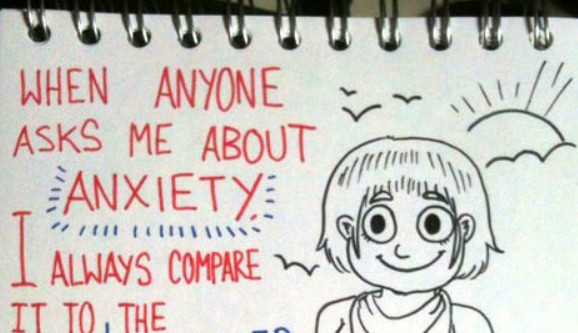
A hand drawn picture of a smiling woman, with the writing: when anyone asks me about anxiety, I always compare it to...

Anxiety is often lumped in together with depression, but it’s its own separate thing. You can have either one without the other. However, one thing “depression” and “anxiety” have in common is that they are both words that refer to a passing mood in the general parlance, so that people who have never experienced the mental disorder think they know what it’s like when they really have no idea. Kind of like the way non-noise-sensitive non-HSPs think we hear what they hear, and can’t understand why their leaf blower or barking dog is driving us bonkers.

Check out this illustrated explanation of anxiety from the inside, by artist Sophie Wright.

We need to stop using the same words for passing moods and full-blown mental disorders.

We need to stop using the same words for passing moods and full-blown mental disorders. It not only keeps people who don’t have the mental disorder from understanding people who do, it keeps people who do have it from recognizing it. I thought (and spoke) of myself, deprecatingly, as “a worrier” for years, as if it was some kind of amusing personality quirk. Even now, I often forget that for most of my 35 years as an undiagnosed depressive, I was also racked with anxiety about pretty much everything, every single day.

If you agree, email this post to your favorite research psychologist, or better yet, to the American Psychiatric Association, which publishes the Diagnostic and Statistical Manual of Mental Disorders in which psychiatric conditions are named.

When Personality Traits Collide: Clifton Strengths A-B

Cover of the book, Strengths Finder 2.0I’m working my way through the list of Clifton strengths alphabetically, a few strengths at a time. That way I can thoroughly process them before I move on to the next group (like the HSP introvert I am!).

Each section in Strengths Finder 2.0 begins with a long paragraph describing the feelings, mindset and behavior associated with the strength under discussion. Next comes a “how it sounds” section, with quotes from several people about their experiences with the trait. I find this section especially helpful, as the language they use is often different from the description paragraph.

Next comes “Ideas for Action,” which lists ways to work with your strength so it doesn’t drive you – or the people around you – crazy. The approach to each strength is relentlessly positive, beginning with the strategy of framing arguably neutral personality characteristics as “strengths” in the first place. However, it is obvious from reading between the lines that each type can be unhappy and/or obnoxious with a mismatched environment or companions.

This brings to mind Marianne Cantwell’s assertion that “a weakness is a strength in the wrong environment,” a reframe which is probably not original to her, but which gave me much hope when I first read it. Gallup (the organization behind the Clifton Strengths system – yes, the poll people) is upfront that their agenda is to encourage people to work with their personality rather than beating their heads against the wall trying to be what they’re not. That’s hard to argue with.

Each strength description wraps up with a few words to the wise for those who find themselves interacting with people who have that trait. Advice is given on what they will be best at, and where to adjust expectations, or allow them some latitude.

The A through B strengths are Achiever, Activator, Adaptability, Analytical, Arranger, and Belief. Achiever is the only one I read last time I had the book, and as I’ve mentioned, it resonated. This left me wondering whether I’d find the other strengths equally easy to identify with. Continue reading