 There are many depictions of non-usual mental states in story and song, including some excellent first-person representations of mental disorders. Edgar Allan Poe, for example, is famous for his accounts of psychotic breaks in the first person. Sometimes we know we are witnessing “madness,” as Poe called it, but sometimes these descriptions are framed as something else. Continue reading
Sensitive Type
Elaine Aron, as my HSP readers may know, is the leading researcher on high sensory processing sensitivity. A year or so ago she took a look at the advancement of awareness about HSPS and decided it “wasn’t happening fast enough.” I imagine she would like to retire, but wants to ensure that the research and education is carried on.
The result was a film, Sensitive, The Untold Story, which premieres in San Francisco in September. You can see the trailer here, and buy tickets here.
 I initially watched the development of this project with some trepidation, since public perception of me and every other HSP may be shaped by it for years to come. I am deeply grateful to Elaine Aron for the research that changed my life, but media savviness is not her strongest suit. However, many other people, including HSP Alanis Morissette have participated in this project (of course, with HSPs, it would be highly collaborative), so at this point, I am just curious to see what they have come up with.
I was touched by the trailer. Continue reading
Life is Weird
So, after two months of no activity whatsoever in my newly chosen career, I suddenly have two clients this week, and both seem promising – that is, both will be good to work with, and need ongoing services.
This is also a week when I’m completing a project that put me in a highly stressful construction environment for the past few months. With the jackhammers shaking the building, and constant voices of workers shouting to each other over the racket day and night, I’ve felt like I was in a war zone.
It’s great to get away from that, but there are endless closing details to manage. If I could, I’d have chosen to do nothing else this week. Instead, I’m doing everything else! I wasn’t sure I could, but I am.
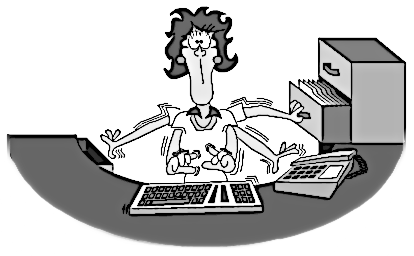
And that’s a general theme of my life lately. I’m scrambling to keep up all the time. Continue reading
Turn, Turn, Turn
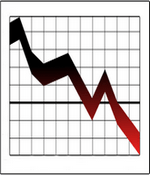 Much has happened since I last posted. My first month in my new consulting career was pretty good. My second month was slower, but I figured there would be ups and downs at the beginning. However, when I had zero clients in month three, I realized I’d drastically overestimated demand, or else drastically underestimated how much promotion I’d need to do. Before I had time to figure out which, my tottering finances crashed. Continue reading
It’s only a couple of hours
My noise-sensitive readers will have heard this before, probably many times. It never fails to enrage me. As if it’s perfectly OK to render the homes or workplaces of other people unusable, and rearrange their plans around yours without their consent for any length of time! Those are MY couple of hours, and I choose what I want to do with them!
 IT IS NOT OK TO INFLICT INTRUSIVE NOISE ON OTHER PEOPLE. IT IS DISRESPECTFUL, PRESUMPTUOUS AND ABUSIVE.
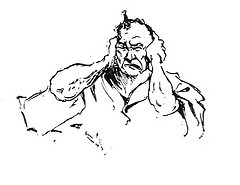
STOP IT!!!
Many people have filters where they can selectively ignore unwanted noise, though even they feel tired after spending hours with persistent background noise. Ignoring takes energy, whether you are conscious of it or not.
For those of us without filters, the experience – and the impact – of unwanted noise is exponentially more intense. And it escalates.
It’s like this: A man with a rubber mallet is standing next to me. He is slowly, rhythmically hitting me on the head with it. With each strike he hits harder.
Or it’s like this: A predatory animal has reached into my skull and captured my brain in its vicious claws. My brain twists this way and that, trying to free my attention for my own use, but it can’t escape.
Noise pollution adversely affects the lives of millions of people. Studies have shown that there are direct links between noise and health. Problems related to noise include stress related illnesses, high blood pressure, speech interference, hearing loss, sleep disruption, and lost productivity.
Environmental Protection Agency
CAUTIONARY TALE
Read James Thurber’s The Whip-poor-will, and if someone in your sphere is complaining about noise you are inflicting on them, listen – before it’s too late.
Better Judgment
 Ever since a youthful epiphany, during which it occurred to me that someone else’s internal experience might be notably different from my own, I have believed I had an above-average consciousness of that insight.
Lately, I’m not so sure. As I explore the 42 personality traits of the Clifton Strengths system, I become increasingly aware of just how broad and deep the variation in personal perception and reaction is. And the more aware of it I become, the more I realize just how judgmental I am. Too often, I assume everyone thinks and feels as I do, and if their behavior is not what I think should be consistent with that, I disapprove.
Why do I do this, I asked myself? After pondering, I came to see that judgment is a form of whistling in the dark. There’s probably a better way to make peace with the perpetual unknowability of everybody else’s private landscape, but I haven’t found it yet.
HSPs are often credited with a gift for perceptiveness. Well, maybe. There have been many occasions throughout my life when feelings and motivations that were glaringly obvious to me were completely invisible to others (sometimes even to the people who were having them).
 But there have also been times when I was wildly, completely wrong about what was going on (like thinking I was an extrovert for the first 53 years of my life). Deep engagement may show us more, but it also means stronger reactions, and strong reactions are not necessarily a friend to accurate perception.
Maybe the intermittent nature of this gift is part of the problem. Because some people are transparent to me some of the time, it’s more threatening when someone isn’t.
But maybe it’s just my particular history that makes me nervous around people who are opaque. I saw what my family didn’t want to admit, so I was told I was crazy at regular intervals throughout my childhood. As a result, I’m never quite sure how much to trust my own perceptions.
That’s damned uncomfortable for me, but since I am, in fact, NOT 100% accurate in my perceptions (or even close) it keeps me humble (relatively), which probably makes me a more pleasant person to be around!
There’s another factor, which I’m becoming more conscious of lately. My preference to hang out with myself alone most of the time inevitably restricts the amount of feedback that is available to me about other people’s thoughts and feelings. Now that I have a better understanding of who I am most compatible with and why, maybe that will evolve over time.
I’ve had occasions lately to discover who my friends are (and aren’t), details of which I’ll save for another post. Maybe having more interactions with people who are demonstrably in my corner will one day make me braver in the face of those whose intentions are unknown.
Sounds of Silence
 The irony of this warning against the perils of earbuds was too perfect to keep to myself. Certainly pouring sound in to excess has its risks. But for some of us, ear buds are the bulwark that shuts sound out. I live in my ear buds, waking, and often sleeping – on the street, in the store, on the bus, and even in my own living room. Every day, I am profoundly grateful for the refuge they provide me from a cacophonous world.
I still use the same pair of Panasonic ear buds I reviewed last fall. It’s been almost a year since I bought them, and they are going strong, despite heavy use every day, and many nights. I use them to listen to what I want to hear, but even more as armor against marauding noise that raids my private brain to obliterate my concentration. Why isn’t that a crime??
I have discovered a silent etiquette of ear buds. Putting them in can cause fellow bus riders sitting nearby to tone things down a notch, without my ever having to look their way or say a word. It’s funny how this works with people who probably would not respond well to a frown or a verbal complaint. Are they even conscious of their adjustment, or do they just react automatically because they know what it means when they put in their ear buds?
My perception of walking around in ear buds has changed radically since it first became common. I used to think people who did that were rudely disassociated from the common experience. Examining that viewpoint with more consciousness, I see it’s based on a rather extrovert-centric assumption that all people should always be ready for engagement with others at all times and in all places. Did I ever believe that? Well, if I did, I’m over it now!
Silence is the sleep that nourishes wisdom.
Francis Bacon
Call Louder, Won’t You?
 As regular followers of Sensitive Type will know, I’ve been struggling for a long time to find a path that worked for me. Along the way, I followed a bunch of blogs about making a living online and/or by blogging. For awhile, I did a lot of reading. Sometimes I wondered whether it was a good investment of my time, especially with the financial wolves howling at my door.
It seems like I only use about 1/10th of what I’ve read, but since I’m forging my path in introverted solitude, it’s worth all that less-useful reading when I find something that affirms my own experience. The post below is an example:
The Complicated But Beautiful Process of Finding Your Calling
While I agree 100% with the title of this post, my perspective differs from the author’s on several points. First, he doesn’t mention luck, which IMHO plays a huge role in the success of any endeavor. After reading numerous success stories, I noticed how often fortuitous timing was a major factor, a point not always noted by the writers themselves.
Aha!? Uh-uh.
Secondly, aha moments are over-rated. Even if you have one, the story doesn’t end there. I’ve had many. Continue reading
Anxiety
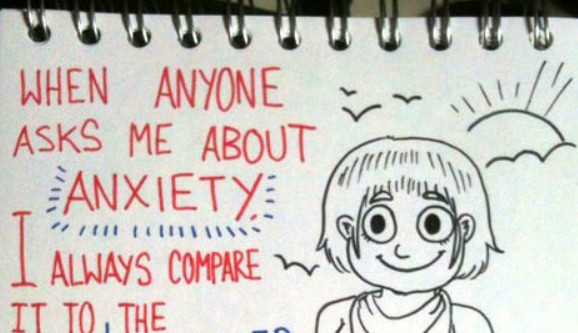
Anxiety is often lumped in together with depression, but it’s its own separate thing. You can have either one without the other. However, one thing “depression” and “anxiety” have in common is that they are both words that refer to a passing mood in the general parlance, so that people who have never experienced the mental disorder think they know what it’s like when they really have no idea. Kind of like the way non-noise-sensitive non-HSPs think we hear what they hear, and can’t understand why their leaf blower or barking dog is driving us bonkers.
Check out this illustrated explanation of anxiety from the inside, by artist Sophie Wright.
We need to stop using the same words for passing moods and full-blown mental disorders.
We need to stop using the same words for passing moods and full-blown mental disorders. It not only keeps people who don’t have the mental disorder from understanding people who do, it keeps people who do have it from recognizing it. I thought (and spoke) of myself, deprecatingly, as “a worrier” for years, as if it was some kind of amusing personality quirk. Even now, I often forget that for most of my 35 years as an undiagnosed depressive, I was also racked with anxiety about pretty much everything, every single day.
If you agree, email this post to your favorite research psychologist, or better yet, to the American Psychiatric Association, which publishes the Diagnostic and Statistical Manual of Mental Disorders in which psychiatric conditions are named.
When Personality Traits Collide: Clifton Strengths A-B
 I’m working my way through the list of Clifton strengths alphabetically, a few strengths at a time. That way I can thoroughly process them before I move on to the next group (like the HSP introvert I am!).
Each section in Strengths Finder 2.0 begins with a long paragraph describing the feelings, mindset and behavior associated with the strength under discussion. Next comes a “how it sounds” section, with quotes from several people about their experiences with the trait. I find this section especially helpful, as the language they use is often different from the description paragraph.
Next comes “Ideas for Action,” which lists ways to work with your strength so it doesn’t drive you – or the people around you – crazy. The approach to each strength is relentlessly positive, beginning with the strategy of framing arguably neutral personality characteristics as “strengths” in the first place. However, it is obvious from reading between the lines that each type can be unhappy and/or obnoxious with a mismatched environment or companions.
This brings to mind Marianne Cantwell’s assertion that “a weakness is a strength in the wrong environment,” a reframe which is probably not original to her, but which gave me much hope when I first read it. Gallup (the organization behind the Clifton Strengths system – yes, the poll people) is upfront that their agenda is to encourage people to work with their personality rather than beating their heads against the wall trying to be what they’re not. That’s hard to argue with.
Each strength description wraps up with a few words to the wise for those who find themselves interacting with people who have that trait. Advice is given on what they will be best at, and where to adjust expectations, or allow them some latitude.
The A through B strengths are Achiever, Activator, Adaptability, Analytical, Arranger, and Belief. Achiever is the only one I read last time I had the book, and as I’ve mentioned, it resonated. This left me wondering whether I’d find the other strengths equally easy to identify with. Continue reading
 sensitive type