
The (Over)Thinker

An outdoor casting of Rodi's famous bronze statue, "The Thinker"This article proposes an adjustment to a widely used theory in psychology, shifting the definition of “neuroticism” from overly reactive to highly reactive, and concluding that such reactivity offers benefits in the form of foresight, creativity and drive, not just the costs of anxiety and depression. Do I see subtle signs that HSP and introvert advocates are making a dent?

Those who have wrestled with depression and/or anxiety will immediately recognize the references to “Self Generated Thought.” There’s actually an acronym for that, SGT. Who knew? It’s more judgmentally known as “brooding” by those who never do it.

Just because everything’s been said doesn’t mean everybody’s heard it.

I thought for most of my early life that I had very little imagination. In fact, I despaired over it in my twenties, around the same time I realized that everything profound had probably already been said. (I later realized this doesn’t really matter, since wisdom needs a constant stream of carriers across the generations to keep it alive and relevant. Just because everything’s been said doesn’t mean everybody’s heard it).

Twenty years later, when I became conscious of “negative self-talk” and other fantasies of doom that fueled the ouroboros loop of depression, I was ROFL at the notion that I had no imagination. Au, so contraire! In reality, I was constructing scenarios in my mind non-stop. Almost all of my energy went into it. Maybe the content needed a little tweaking, but it had been irrefutably established over decades that I was not only creative, I was extremely focused and prolific!

Go Wormy, Be Happy

[If you tried to access the link before, it’s fixed now. Sorry about that.]

How far would you go to relieve your depression? Would you go to helminth?

Where, or what, you may ask, is helminth?

Candy shaped like a knight’s headgear?

Hardly.

An herb on the banks of the the river Styx?

Good guess, but no.

No, a helminth is a worm. A parasitic worm, to tell you more than you probably wanted to know. Also, perhaps, the next big depression cure.

You think I’m making this up, don’t you? Hah, are you in for a surprise when you read this article! Don’t say I didn’t warn you.

(Actually, I have heard of this before. People have been self-experimenting with them for more than a decade. It’s nice to know the scientific community has finally caught on. Me, I’ve considered zapping my brain with a homemade tDCS unit, but eating parasites? That’s just icky. Then again, ask me in January…).

Everybody talks about the weather, but nobody does anything about it

About those other things that have been going on with me lately? One of them is the weather. We just had a nasty heat wave, and I have Seasonal Affective Disorder.

A SAD State of Affairs

SAD, or, as it is officially (but inaccurately) known, Major Depression with Seasonal Pattern, is clinical depression in response to factors in the physical environment.

A graphic of a sun with a female face and rays blowing across it as if a breeze is blowing from the left sideWinter SAD, which you may have heard of, results from insufficient exposure to light. It was first observed as a winter-related phenomenon, since sunlight is weaker, days are shorter, and clouds are more common during winter in many climates.
However, SAD can also be found year-round in people who work at night and sleep during the day, or even those who live in sunny places but spend very little time outdoors. That makes the name misleading, and the official diagnostic criteria just plain wrong in far too many cases.

Summer SAD, which you probably haven’t heard of, is major depression triggered by heat, usually in conjunction with humidity (I’m fine in the desert). It also is not necessarily seasonal, but can occur wherever someone is exposed to hot and humid summer-like conditions, whether natural or artificial.

I have both types of SAD. Continue reading

Picturing Depression & Anxiety

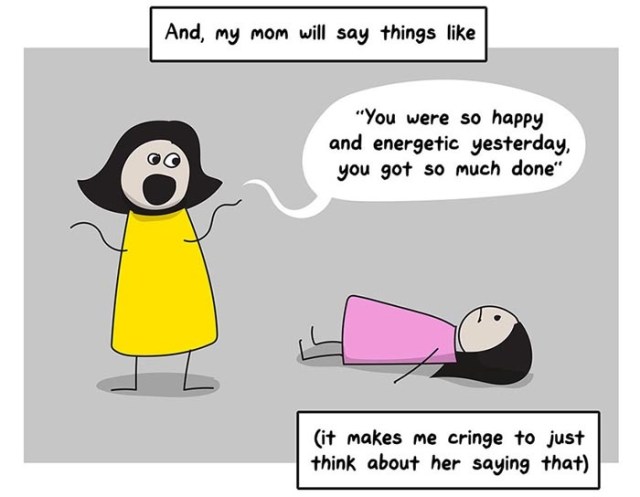
Just wanted to share Nick Seluk’s great comic strip, inspired by Sarah Flanigan’s story of what it’s like to live with depression and anxiety. Here’s a frame a lot of us will recognize, but definitely check out the whole thing.
Comic of a standing adult saying You were so happy and energetic yesterday, you got so much done, to a child lying on her back

Are You Happy Now?

Four exactly alike smiling faces made from a banana mouth, orange slice eyes and a strawberry noseI view the “happiness movement” with skepticism. If you aren’t familiar with it, it argues that unhappiness comes from framing our experiences “negatively,” and if only we reframe them “positively,” we can be happy. Here’s a TED talk from one of its most visible proponents.

Note that our speaker, cruising on the silken waters of Harvard cachet, is marketing a service to large corporations. If your boss sent you to happiness school, would you dare to test less happy at the conclusion of the class? No wonder this guy is happy. He’s found himself a sure thing! Continue reading

Depression Inside Out

There are many depictions of non-usual mental states in story and song, including some excellent first-person representations of mental disorders. Edgar Allan Poe, for example, is famous for his accounts of psychotic breaks in the first person. Sometimes we know we are witnessing “madness,” as Poe called it, but sometimes these descriptions are framed as something else. Continue reading
Anxiety

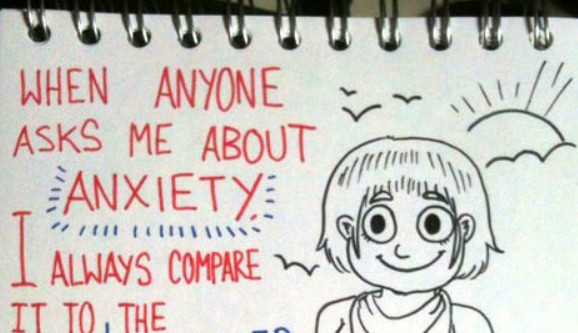
A hand drawn picture of a smiling woman, with the writing: when anyone asks me about anxiety, I always compare it to...

Anxiety is often lumped in together with depression, but it’s its own separate thing. You can have either one without the other. However, one thing “depression” and “anxiety” have in common is that they are both words that refer to a passing mood in the general parlance, so that people who have never experienced the mental disorder think they know what it’s like when they really have no idea. Kind of like the way non-noise-sensitive non-HSPs think we hear what they hear, and can’t understand why their leaf blower or barking dog is driving us bonkers.

Check out this illustrated explanation of anxiety from the inside, by artist Sophie Wright.

We need to stop using the same words for passing moods and full-blown mental disorders.

We need to stop using the same words for passing moods and full-blown mental disorders. It not only keeps people who don’t have the mental disorder from understanding people who do, it keeps people who do have it from recognizing it. I thought (and spoke) of myself, deprecatingly, as “a worrier” for years, as if it was some kind of amusing personality quirk. Even now, I often forget that for most of my 35 years as an undiagnosed depressive, I was also racked with anxiety about pretty much everything, every single day.

If you agree, email this post to your favorite research psychologist, or better yet, to the American Psychiatric Association, which publishes the Diagnostic and Statistical Manual of Mental Disorders in which psychiatric conditions are named.

I’m OK. No, really.

There’s a drought where I live. Drought is a terrible thing for wild animals, farmers, and lawns. But for me, endless sunny days are a dream come true. My name is – well, never mind – and I have Seasonal Affective Disorder.

Don’t let anybody tell you there’s no winter in coastal California, because there is. I admit, it’s a kinder, gentler winter, but in an average year, 4 inches of rain a month for 4 consecutive months results in significant solar inhibition. That’s when I hunker down in front of the light box, cancel my expectations, and hope life doesn’t throw me any curves for the duration.
Sun breaks through clouds and reflects off of a creek in a verdant landscape
I used to live in a place with 300 cloudy days a year. Continue reading

Checking In

Close up of the face of a large turtle looking inquisitively into the cameraHas it really been a month since I posted? Sorry about that. On something of a whim, I started a daily post series on one of my other blogs. I had been neglecting it ever since I started Sensitive Type. The flurry of posts were an act of defiance against the obstacle that kept me from doing what I loved, even though I knew that obstacle was probably me.

I kept it up for three weeks.
Continue reading

Depression and Self-Hypnosis

Here are a couple of great links I stumbled across recently.

Cognitive Distortions: The Lies Depression Tells is an excellent article about how depression affects our inner dialogues.

Are you prepared to be Hypnotized… by yourself? is a great ‘self-hypnosis “how-to” for beginners.’ I experimented with self-hypnosis recordings that I made myself a year or two ago. My scripts centered on self-understanding and settling anxiety. The effects were so gradual and natural that I hardly noticed them at the time (which is typical of hypnosis results), but in retrospect I can see that’s when I started making breakthroughs in self-discovery. Hypnosis was also very helpful for physical feelings of intense anxiety that I was experiencing at the time.

While this is a nice article in many respects, don’t worry too much about the recommendations (daily practice, an hour at a time, and never in bed). I broke all those rules and it still worked for me. The most important thing is just to do it.