Wisdom – I Don’t Get It

Just because we can conceive of a thing doesn’t mean it exists. Take objectivity, for example. We know subjectivity exists, because if you ask five people the same question, they will show it to you. And the omnipresence of subjectivity begets speculation about what the absence of subjectivity might be like. So we give that a name and try to enshrine it in our policies of fact and justice, as if it makes perfect sense for an absence to prove a presence.

But how does it? Who could be unbiased? Where is the place, external to all interests, that an unbiased person could stand?

And then there’s peace. The idea of peace, that is. There’s a transitory internal experience with that name, which begets speculation about a world where everybody could feel that all the time. So we extrapolate from the subjective to the objective, and put the redefined word on posters and jewelry and demonstration signs, and in sermons and meditations and prayers and pleas, and ignore most of human history, as if saying it enough times must call it forth.

A white peace dove painted in the circular center of a vaulted roof

But humans are a quarrelsome lot, or at least enough humans are that the rest of us can’t steer clear of their fallout, which makes peace about as concrete as objectivity.

Do they really do us any good, these aspirational ideas, or do they only cause us pain? The activist manual insists they keep us striving for improvement, like that’s beneficial. But maybe improvement is yet another of those dubious abstractions. Is there any evidence humans as a species are growing mentally and emotionally? Or have we conflated biological evolution with technological invention, and arbitrarily – or wishfully – designated the latter as evidence of the former? Our inventions include the means to destroy the planet, and every life upon it, but not the means to preserve and nurture all that.

The thing about evolution is, it works on a grand scale, encompassing multitudes of lives and eons of time. Evolution paints in broad strokes, and doesn’t trouble itself with petty details, like the faces of individuals whose lives wink in and out in the blink of a cosmic eye. A subset of pursuers of peace, objectivity, improvement and wisdom just large enough to keep the quarrelsome majority from self-annihilation is “mission accomplished” for evolution. Evolution doesn’t care whether such a role is eternally, excruciatingly cruel to that minority contingent. Enlightenment is irrelevant to evolution. Only perpetuation scores.

And if the tendency of humans to kill each other by the thousands seems wasteful, that’s a prejudiced view that overestimates our significance to the ecosystem. There’s a hungry food chain full of microbes and insects and other scavengers to be fed, and one species of corpse is as good as another. It’s only in our own estimation that our minds are more important than our meat. Ecologically speaking, we’re probably more useful – and definitely less harmful – as dinner.

So if we aren’t actually evolving, or even capable of it, what does constant striving get us, besides tired?

There are moments of piercing beauty in the world but you can’t catch and hold them to shield you from moments of piercing horror.

 
This is where I start to feel the need of wisdom. Do I dare to infer there is such a thing from the glaring lack of it everywhere I look? Hardly sounds logical, does it? Ergo, I dare not. I merely wish, wistfully.

Religions lure us with authenticated keys to wisdom, or so they say, but if you want to try, you have to buy. The cost in time and submission is dear, and if you are unsatisfied with your purchase, they’ll say you haven’t paid enough yet.

Their positions on striving vary. Some favor it, so long as you strive per their instructions, no questions asked. Others oppose striving, but strive not to strive. This doesn’t inspire confidence in their guidance to an understanding that answers all questions and heals all wounds.

Is it cynical to question whether the good fight is a purpose sufficient unto to itself, regardless of unproved assumptions, or results? Or is it wisdom to come to peace with an objective assessment that improvement is a fantasy? But wisdom, peace, objectivity and improvement are all fantasies themselves, so how can I? I can only continue to grieve for what I can hold in my heart, but never, ever touch.
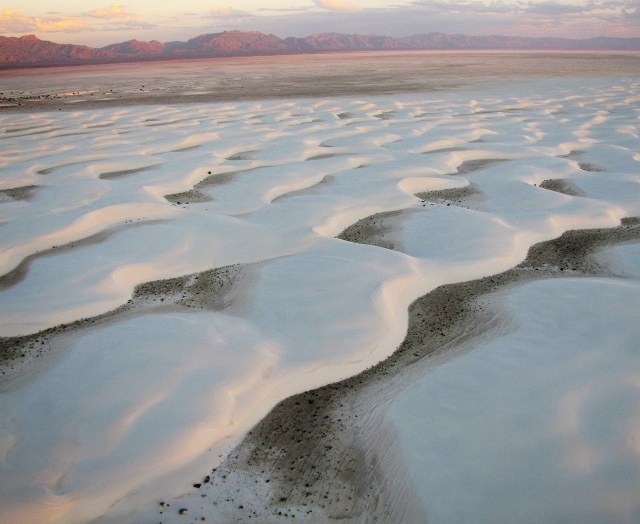
A large desert plain with a rippled white sand floor, edged with stony mountains in the far distance lit by a rising or setting sun.


Terra Infirma

I knew I was living in a protected bubble, where life AC (After COVID-19) was not so very different from life BC. I knew there were similar pockets throughout the U.S. While I was grateful for the relative safety of my situation, the sense of removal from the chaotic centers of the pandemic has its down side. Many in my suburban city refuse to change their behavior. They are worried enough to hoard toilet paper, but not enough to keep their distance in the checkout line. They don’t know anyone who died yet.

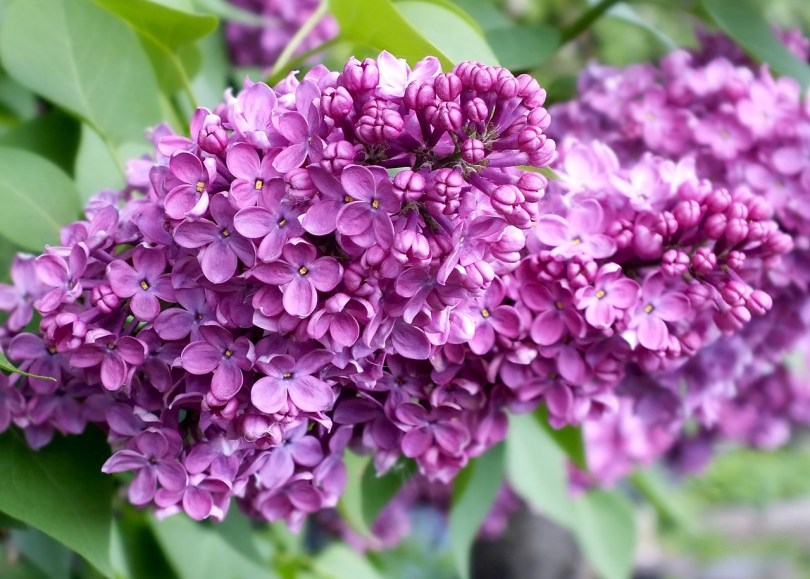
Two blooming purple lilac flower heads

The disconnect between the quiet streets here, blooming with spring, and the fact that we are in the midst of a global tragedy that must change us in ways we can’t even begin to imagine felt increasingly surreal as I read of very different scenarios elsewhere – Italy, Spain, hospitals in New York. But still, I worked my past experiences with making do, getting through it, living with uncertainty, and sheltering in place from my own HSP overwhelm. I told myself calmly and rationally that the brightest and best-trained minds on the planet are working on this, Continue reading

Processing

I discovered living alone (without other humans, that is) when I was 16, and with the exception of brief sojourns with lovers or short-term transitional situations, it has been my lifestyle of choice ever since.

Close Quarters

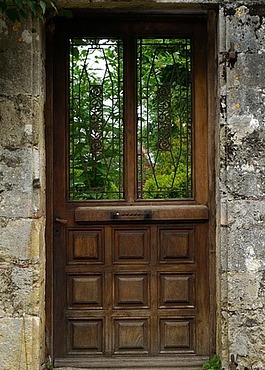
Leafy trees show through windows in a wooden door set in a stone wall.Living with other people was what I turned to when I first struck out on my own because it was what I had always done, but I soon realized the omnipresent relationships placed unmanageable demands on my energy. Sometime in my teens I redefined “home” as “the place I go to get away from people and rest.” And that is what home still is to me.

I rarely invite people in. If I feel social, I go out.

Most of my friendships are situational, the sum of proximity + time. That used to feel inadequate, but perhaps my expectations have evolved as I become a better friend to myself. The differences seem less important. Sometimes, as friendships deepen, I discover there are more similarities than I suspected. Continue reading

Life After Death

Thanks to my readers who have sent their comfort. It does help.

After the past two weeks of constant intensity, I’m feeling a little numb. I think I reached my limit, and my emotions automatically shut off to give me some rest. I’ve been cleaning the house, catching up on neglected work, donating the leftover medications to the animal shelter.

I can’t really get away from it, of course. The house is too quiet, and wherever I look, there are signs of the life with three cats I used to live. Winter came while I wasn’t looking. The cold lurks in corners, ready to envelop me the moment the heater ticks off.
A sunset over a frozen lake
The surviving cat has never been alone in the house in her entire life. The first time I left her, after… she ran and hid when I came home. She came out when she realized it was me. It was someone coming in the door that had frightened her. The last person who came to the house was the vet who euthanized her sister.

I always wondered how the cat dynamics would change when there were only two, but it never occurred to me I might lose two at the same time.

Mom and daughter will be cremated together. It wouldn’t surprise me if my emotions come back when the ashes are returned to me in a couple of weeks. I’m grounded in the physical realm – cremation has always seemed more final to me than death, as if, as long as the body which was the vehicle of our connection still exists, that connection is not really broken.

In the end, one cat died “naturally,” and I had the other euthanized when every breath became a struggle. Neither of these was a “good” death. Maybe there is no such thing.

Stages

My life has been in crisis for the past 2 – or is it 3? – weeks. Time is elongated, and the last time things were “normal” seems like a long, long time ago.

I knew my animal companions were getting on in years, and could not live forever, but I shoved that awareness to the back of my mind, because I couldn’t conceive of how to live with losing them. It’s been getting harder to ignore since a scare earlier this year, and now it may be unexpectedly upon me. And I still don’t know how.

Caretaking animals is not so very different from caretaking humans. Sometimes, all you can do is keep them clean and warm and dry, but it’s worth doing. After a day at the vet with one cat, I came home to find another hiding under the bed. It’s been almost 36 hours since she would eat anything, and she is a walking (or rather, stumbling) skeleton already. There is nothing left to do for her if she won’t eat. Continue reading

Unabated Breath

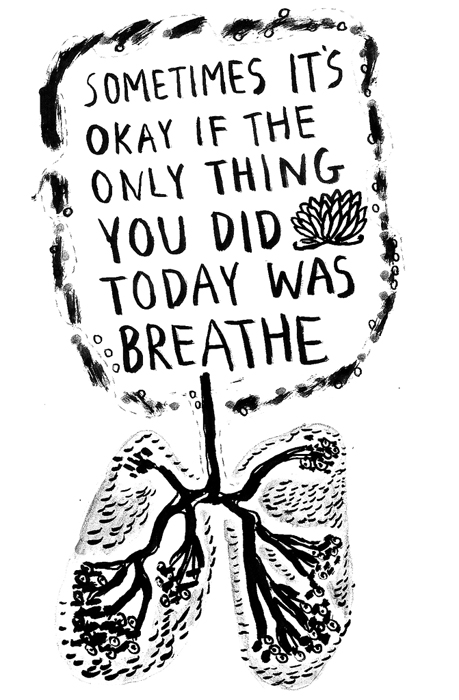
A cartoon of lungs, with the words "sometmes it's OK if the only thing you did today was breathe."This cartoon by Yumi Sakugawa caught my attention for two reasons. First, it affirms my introvert/HSP/recovering depressive need for downtime.

But the second reason is something I’ve been wrestling with for several weeks now. I’ve become aware that a lot of my abdominal muscles live in a constant state of contraction. This is so automatic that I’m utterly unconscious of it most of the time. Even when I turn my attention to those muscles, it’s hard to figure out how to relax them. And the minute I start thinking about something else, they revert to their habitual contraction again.

The contracting is complex. There are at least three different areas involved, and if I try to relax them in the wrong order, the first group contracts again when I relax the second.

One set of muscles is around my waistline, and sucks my abdomen in under my diaphragm. You know, into the space where air is supposed to go when you breathe deeply? I have often noticed that I had trouble taking deep breaths during exercise or yoga. Now I realize it was because I was fighting against the inflexible girdle of my own muscles. What impact has constant under-oxygenation for all those decades had on my physical and mental health?? Continue reading