Yes, there is a day just for us!

Yes, there is a day just for us!
 I’ve been hearing buzz about Medium here and there for awhile now. If you haven’t heard of it yet, it’s a newish online sharing platform meant for deeper, more thoughtful articles and responses than social media and commercial sharing venues typically offer.
That sounds like something designed by (and for) introverts, no?
But I’ve been scrambling to make financial ends at least wave at each other from opposite ends of the block, so it wasn’t until tonight that I finally took a look.
I didn’t look far before I found Multitasking is Killing Your Brain. Hah! I was right! It’s a den of introverts! Here I was thinking Introvale was a physical space. Silly me.
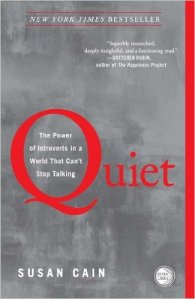 Jenna, my comrade in bloggery over at The Wishing Well, just published a post about Susan Cain’s book, Quiet: The Power of Introverts in a World That Can’t Stop Talking. To my great surprise, her reaction to it was very different from mine. Since I had recommended it to her enthusiastically, I started out writing a reply in a comment, but it became way too long, so I’m publishing it here.
Wow, did we read the same book? Before I read Quiet, it had literally never crossed my mind that I was an introvert, much less an HSP (which Elaine Aron believes Susan Cain also is). I thought I was an extrovert inhibited by a tendency to isolate. I defended this, extolling the joys of solitude, as I still do. However, before I read Quiet, those joys were seriously undermined by my secret fear that solitude was an unhealthy indulgence, an escape from my shameful inability to interact “normally.” Whether it was my failure to produce extroverted bubble and bounce on command, or my persistent inclination towards behavior I had been taught was dysfunctional, I was coming up short no matter what I did. Continue reading
My brain is abuzz with all of the things I read and see that I want to share with you. The backlog is getting too huge to ever catch up, though, so I set up a Facebook page where I can post things that don’t make it into a SensitiveType blog post. Check it out (there’s also a link in the right sidebar).

Meet Michelle Kingdom, another introvert artist with a new twist on an existing art form.
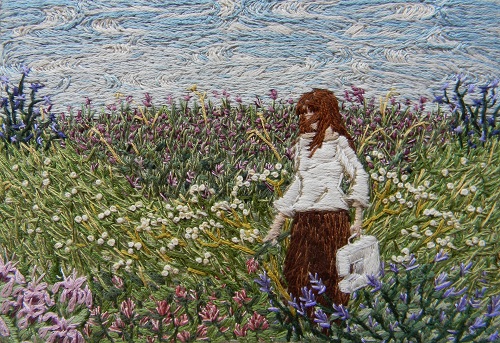
Her horizon seemed to her limitless
She doesn’t say she’s an introvert, but when she talks about the privacy of her unique art – well, we can read between the lines. And once you see her images, and her titles – which are a very important part of her work – there can be no doubt. Those who think of introverts as loners may be surprised that most of her pieces include more than one person, and that even when they appear to be inwardly focused, she portrays them as interconnected.
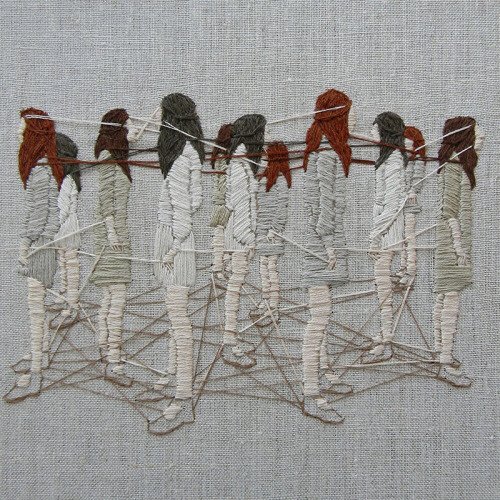
Duties of gossamer
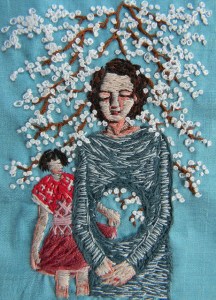
Little by little there was scarcely anything left
Sometimes, the carefully chosen titles say it all. Other times, they are intimate, yet cryptic, implying unspoken details beyond the edges of the scene, or multiple possible stories, with the context left open for the interpretation of the beholder.
Most intriguingly of all, these works are tiny, barely as wide as a woman’s hand.
I’m such a wordy person. I always have been. Words pour out of me like spring snow melt racing down a mountainside. Which is why I understand so very deeply and completely all of the things that words can’t do.
If you’re about ready for a laugh, I’m pretty sure you’ll find one somewhere in this set of introvert-related cartoons from artist Aaron Caycedo-Kimura.
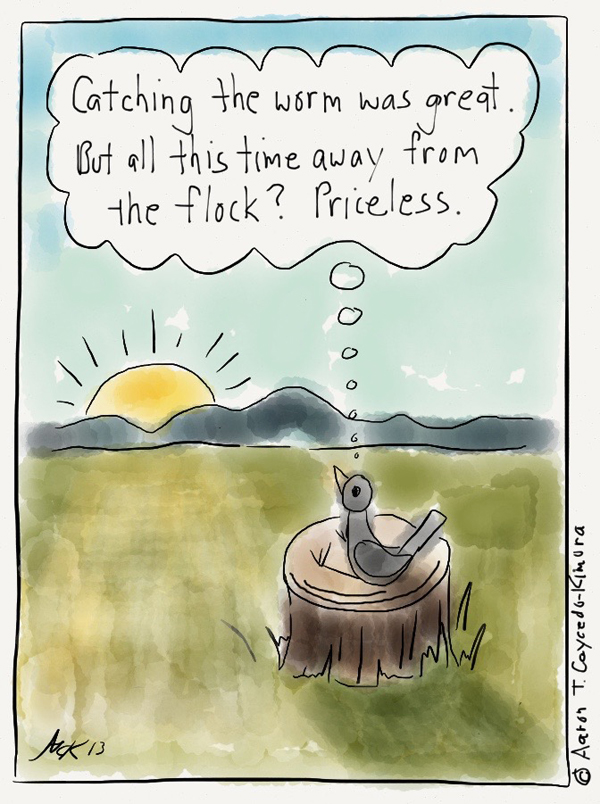
But wait, there’s more! Here’s his INFJoe site, with more cartoons. What a coincidence – I’m an INFJ (except when I’m an INFP). And the blog theme he’s using (Dusk to Dawn) was the theme I used on my first WordPress blog. I especially like The Scope of Socializing. Also Awkward Walk. And Passing the Phone (somebody stop me before I link them all…)
 I’m working my way through the list of Clifton strengths alphabetically, a few strengths at a time. That way I can thoroughly process them before I move on to the next group (like the HSP introvert I am!).
Each section in Strengths Finder 2.0 begins with a long paragraph describing the feelings, mindset and behavior associated with the strength under discussion. Next comes a “how it sounds” section, with quotes from several people about their experiences with the trait. I find this section especially helpful, as the language they use is often different from the description paragraph.
Next comes “Ideas for Action,” which lists ways to work with your strength so it doesn’t drive you – or the people around you – crazy. The approach to each strength is relentlessly positive, beginning with the strategy of framing arguably neutral personality characteristics as “strengths” in the first place. However, it is obvious from reading between the lines that each type can be unhappy and/or obnoxious with a mismatched environment or companions.
This brings to mind Marianne Cantwell’s assertion that “a weakness is a strength in the wrong environment,” a reframe which is probably not original to her, but which gave me much hope when I first read it. Gallup (the organization behind the Clifton Strengths system – yes, the poll people) is upfront that their agenda is to encourage people to work with their personality rather than beating their heads against the wall trying to be what they’re not. That’s hard to argue with.
Each strength description wraps up with a few words to the wise for those who find themselves interacting with people who have that trait. Advice is given on what they will be best at, and where to adjust expectations, or allow them some latitude.
The A through B strengths are Achiever, Activator, Adaptability, Analytical, Arranger, and Belief. Achiever is the only one I read last time I had the book, and as I’ve mentioned, it resonated. This left me wondering whether I’d find the other strengths equally easy to identify with. Continue reading
These days, I am always running into things that scream “introvert.” The work of Korean artist, Jee-Young Lee is a perfect example. First of all, she has created her own artform. She builds the installations in her tiny studio, and then photographs them. The photograph, a step removed, becomes the art, not the original installation. Ingeniously introverted, no?
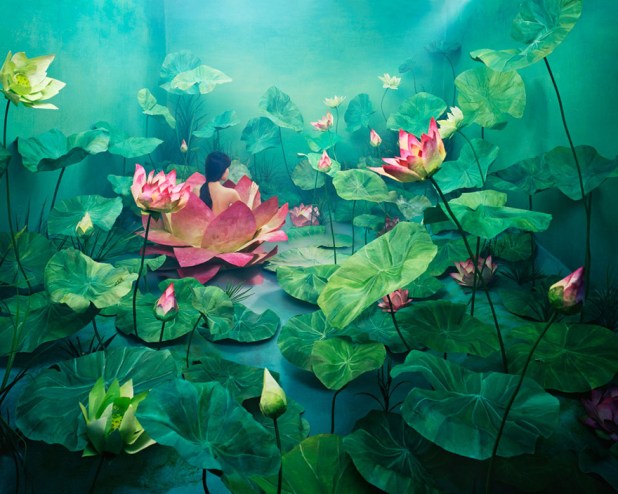
If that isn’t enough to convince you, click on the picture to see more of her work. She is in her own scenes, but always in the background, facing away from the viewer (and always alone). She reveals herself on her own terms, sans interaction.
Then I stumbled across this artist on SNL:
I had never heard of Sia before, and I couldn’t even tell what language she was speaking (Australian English, as it turned out). The contrast between the visceral creative force expressed through her voice, and her withdrawn physical presence was most intriguing. I felt like I was watching an avant garde performance straight out of the 60s.
What do you think? Am I just seeing introverts everywhere because I am one, or am I on to something?
I share this piece from a UK educator site with reservations, as it treats introversion and shyness as interchangeable throughout, which they are not. However, the author makes some good points, and the two sidebars (bottombars, really), one from an educator who proactively reaches out to all of her students (which is, after all, the job of every educator, right?), may be of interest to some of my readers, along with the comments.
Learning that I wasn’t the only noise sensitive person in the world inspired me to be a lot more proactive about avoiding stressful noise. I decided it was time for ear muffs.
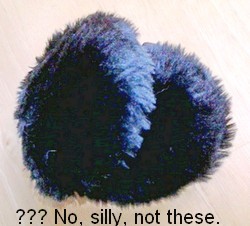 If you’re in a place with cold winters, that may conjure up fluffy images, but it turns out there is another kind. Sound reducing ear muffs are made for people who work with loud equipment, or shoot guns for fun, which explains why I never heard of them until I started reading survival tips from introverts and HSPs.
Continue reading
 sensitive type