 I’ve been grappling with a challenge I variously refer to as procrastination, low motivation, or a need for an astronomical amount of down/processing time, for awhile now. Years, actually. As you can see by my list of labels, the crux of the problem is not solving it (problem-solving is one of my natural strengths), but defining its nature (possibly less of a strength). Longtime readers may recognize this state of bemused non-functionality from the inception of Sensitive Type.
Just to be clear, the tasks I’m having trouble with are self-initiated. Some are associated with work, and I will eventually have to be accountable for them, but there is no one looking over my shoulder from day to day. Others impact only me. Ironically, the space to “be where I am” that I built in to my life in response to my previous crisis reduced the stress of pressure from others, but by also reducing the motivating imperative of deadlines, new stress was born.
Finding the Right Frame
I have framed the issue in many different ways, trying to find one that fits. It’s always tricky when something funky is going on with my brain, because there is such a smorgasbord of possibilities. I have lived with Seasonal Affective Disorder, a form of major depression, since childhood. I suspect I have some level of ADD. I’ve experienced a generous helping of trauma in my life – I feel pretty good these days, but sometimes that stuff lingers under the surface. And last, but not least (and come to think of it, probably not last either), I’m an HSP. So what have I got here, a therapy problem, brain chemistry problem, mismatched lifestyle problem, or “normal” HSP freezing in the face of demands?
I have even considered reframing the problem out of existence. Was it really just a problem with my expectations? But no, alas. Unless you are wealthy (I’m not), there are things that must get done, and get done by you.
I haven’t made much headway, despite reading, discussion, introspection, analysis, etc. Maybe you know the place I’m in, mulling over the same unanswered questions, with no further progress towards answers, again and again. It gets boring, as well as frustrating. Still, as this blog up ’til now documents, persistence does eventually pay off.
Getting the Picture
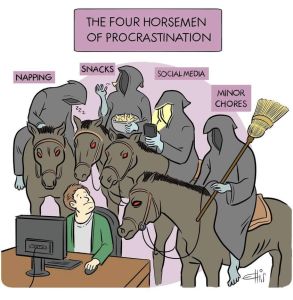
Phone Games is out buying a new charger (Cartoon by Ellis Rosen)
It hadn’t occurred to me until lately that anxiety might be a factor. I do have a vague background feeling of overwhelm that makes anything but that thing I really need to be doing now seem more appealing, even when I know intellectually that I am perfectly up to the task I’m avoiding. But surely that vague background feeling doesn’t rise to the level of anything that could be called “anxiety.” I have experienced severe anxiety on an incidental basis in the past, and I don’t feel anything remotely like that these days.
However, starting a year or two ago, I noticed a suspicious correlation between setting off to do something I really didn’t want to do, and sudden onset of short-lived digestive disturbances that kept me home. Never having had a sensitive stomach, I wrote this off as coincidence for a long time. But eventually, it became too consistent to ignore.
I am taken aback to think I might be so out of touch with my feelings that my body has to step in to hit me over the head (or more accurately, kick me in the butt) with them. Surely not hyper-analytical, introspective me? However, I have had past experiences with being aware of feelings, but not taking them seriously enough. So surprise emotions, or at least, underestimation of emotional impact, isn’t entirely unprecedented.
Coming Into Focus
It wasn’t until today, as I was thinking about writing this post, that it occurred to me the treatments I take for depressive mood symptoms may also be muting my conscious experience of anxiety, while not actually removing the underlying tension. BIG lightbulb there. So maybe overlooking the possibility that anxiety was the problem is not such an inexplicable omission after all.
See, this is what I love about writing. For a super-verbal person like me, the very act of framing thoughts for communication to others can beget new insights.
Finding the Right Outlook
But I digress (I think I will put that on my tombstone).
Now that anxiety is a serious contender for the Answer I have been seeking, I find myself wondering whether it is different from HSP overwhelm, and if so, how. I deliberately did not check to see whether Elaine Aron or other Sensory Processing Sensitivity researchers have previously addressed this question before writing this post, though I will do so afterwards. Instead, I want to explain what makes me ask it, and put it out there for other HSPs, and HSP friends/family and/or people living with anxiety disorders to weigh in with their own perspectives.
First of all, since it apparently cannot be said often enough, Sensory Processing Sensitivity is not a disorder. My experiences in various online forums and support groups has shown me that there are a huge number of HSPs (not to mention oft-abusive relatives, partners, co-workers and employers, and most unfortunately, a high percentage of uninformed health care providers) who confuse HSP sensitivities with symptoms of mental disorders, especially clinical depression. In my opinion, differentiating between SPS and mental disorders is one of the greatest challenges facing HSPs and mental health professionals today.
I’m not going to discuss the differences here, as that would be a whole series of posts all on its own. Suffice it to say that, while being an HSP in a world that isn’t very sympathetic to our personality type can put us at greater risk for mental disorders because we are often perceived negatively, and it’s harder to create living and working environments for ourselves that meet our needs, I do not believe that being an HSP causes mental disorders. This is an essential distinction many people fail to make.
Nor do I believe that we are more fragile than others, and therefore more prone to mental disorders, another common misconception. HSP reactivity cuts both ways. Given a mildly supportive situation, we are likely to get more out of it than a non-HSP.
Posing a Question
Another World (aka Other World II) – M.C. Escher
So, I am resistant to a confusion between SPS characteristics and mental disorder symptoms. However, conflation of the two has largely revolved around symptoms of clinical depression and trauma being mistaken for HSP characteristics – or occasionally vice versa. In those cases, I see a clear distinction between the disorder symptoms and the personality characteristics, and having lived with major depressive disorder most of my life, I ought to know. But what about anxiety? Is that as distinct from HSP overwhelm as HSP emotionality is from depressive/traumatized emotional reactions?
And that is the end of my post. I’m asking.
If you are an HSP, AND have been diagnosed with an anxiety disorder, especially if it improved with treatment, what changed for you after the treatment, and what was the same?
Are you an HSP who is NOT anxious? Please say more about that – I think a lot of HSPs would like to hear it.
If you are also struggling with overwhelm as an impediment to getting things done, what are your workarounds?
If you have an anxiety disorder and are NOT an HSP, but know one, do you see differences between their experience of overwhelm and yours of anxiety?
What if overwhelm turned out not to be an aspect of being an HSP at all, but instead was simply a manifestation of a treatable mental disorder that a lot of HSPs fall prey to? How would that change your life?
 sensitive type
Interesting question. I’m an HSP and have suffered from extreme anxiety for years, although never officially diagnosed or officially treated. Or, would it be more accurately considered hsp overwhelm?
A distinction only seems beneficial if the two conditions have two different ways of being addressed/treated. There is certainly an overlap of helpful treatments, but are these two issues dealt with/treated in fundamentally different ways?
So many questions!
Elaine Aron says “All highly sensitive people worry to some degree… You cannot say someone has an anxiety disorder if it is normal for their temperament to worry more and it does not impair them or cause them distress” (italics mine).
This strikes me as a problematic and questionable position. First of all, when, if ever, is worry NOT distressing? According to Cambridge Dictionary, worry = “to think about problems or unpleasant things that might happen in a way that makes you feel unhappy and frightened.” If “unhappy and frightened” isn’t a state of “distress,” what is? Surely it is also a state of impairment.
To get back to your comment, you asked “are these two issues dealt with/treated in fundamentally different ways?” My concern is that distress/impairment caused by anxiety gets defined out of existence if it is designated as “normal” for HSPs, and therefore isn’t treated/addressed.
Aron seems to be arguing that the defining characteristics of a mental disorder – that it causes suffering and/or undermines functioning to a significant (whoever decides what that means) degree – does not apply to HSPs in the case of anxiety (and possibly depression as well). That is exactly the kind of statement I have seen HSPs cite over and over in posts about how they hate being an HSP, because their sensitivity is misery to them, and since it is a personality trait and not a disorder there is no help for it.
Combined with the stigma associated with mental disorders, this idea that anxiety and depression are somehow “normal” for HSPs is causing a LOT of people to suffer unnecessarily when there are treatments available that could significantly (there it is again) improves their lives.
I am curious, if you feel like sharing, if/how you have been “unofficially” addressing your anxiety? Which came first, recognizing that you had anxiety, or that you were an HSP? Did that impact how you framed/acted upon whichever one came second?
I realize I never responded to you, sorry! Ha!
Im pretty sure I found out I was HSP (2015) before I really understood what anxiety was and that Id actually had it for most of my life. I described the symptoms of anxiety in my journal but had no idea that it had a label – anxiety. I just thought I was weird. I have no idea how I was so clueless on that front and can’t remember now exactly when I figured it out. But im pretty sure the revelation of HSP came first.
I don’t know that I ever directly related anxiety to being an hsp. But Id say I recognize that my extreme sensitivity does lead to more anxiety… Or “overwhelm”. Seriously don’t know the difference haha.
How do I unofficially address my anxiety? That’s kinda like asking “how do you live a healthy life?” For me I try to treat my entire body/mind/life from a holistic standpoint, as it all affects each other. I’ve explored somatic work, personal diet and nutritional or herbal supplements, various forms of exercise/movement, breath work, trying to keep my life organized and not devolve into utter chaos… Lol… Like there’s just so much. As any one part of my life gets better, the rest usually gets better. Random feelings of anxiety or overwhelm is generally a signal that Ive been avoiding feeling or acknowledging certain things that I find deeply uncomfortable, trying to mentally sweep them under the rug. You can tell your mind to forget it but the body won’t forget. But anxiety can probably be viewed as my body going into fight/flight mode, which can be the result of any number of stressors.
There is a lot of trauma I am still working through that can exhibit as anxiety. But trying to pinpoint if Im being triggered by some past trauma resurfacing or if Im just totally thrown off by something in my immediate environment (hsp overwhelm?) that has nothing to do with it… Not always possible to differentiate. Each anxious episode is going to have different triggers and often different treatment, but the underlying issue for me is learning to calm my nervous system by creating a sense of safety in my body. I guess Id say that somatic work has probably been the most helpful as far as a framework of what’s going on and general direction of what needs to happen.
I also wonder if HSPs are more prone to becoming traumatized, because we do feel things so deeply. And then we are told NOT to feel things so deeply. It becomes harder for us to release that emotion/energy because it runs SOOO deep and those around us don’t have the patience to witness how long of a process it can take to feel and release those emotions and experiences. I see this with my own kids. At some point I really want them to stop crying because its just so unpleasant. But sometimes they just need to keep crying a bit longer to release all that emotion/energy. To stifle that process does in a way create a trauma. Because trauma is basically stuck energy.
So maybe its not so much that HSPs might be naturally more prone to becoming traumatized, its that others don’t handle how intense our experiences are, which causes us to shut down out of shame, etc. If there was no stigma of being “too” sensitive, we might recover from our traumas faster because we know its ok to feel everything as deeply and intensely as we do.
I don’t know. Just some thoughts.
What thought-provoking questions! I’ve been mulling since you posted them, and I still am. I know even less about trauma than I do about anxiety, but given HSP Differential Susceptibility (more pronounced responses than non HSPs to positive as well as negative stimuli), your observations about the impact of environment on HSP processing of potentially traumatic experiences makes a lot of sense. Several studies have demonstrated that HSPs might respond much better than non-HSPs to interventions/treatments that are specifically designed for them (https://www.childresearch.net/papers/new/2019_03.html)
I totally agree that suppressed experiences, or maybe I mean suppressed reactions to experiences, can be stored – and perhaps transformed – in a physical way. If you don’t mind sharing, I would be very interested to hear more details about the kind(s) of somatic work you have done.
There have been some developments in my self-understanding around anxiety – or at least in my self-observation – that I’ll be writing about soon. Thanks for coming back to continue this very interesting exploration!